The Desk-Worker Late Starter
What Happens When Your Nunchaku Are Bigger Than They Should Be
The first two pairs came out long and thick, closer to giant-sized than beginner-sized — and training on them anyway turned into an accidental full-body workout.
The first two finished pairs I picked up from Heritage Beam & Board are not sized the way anything I’ve read tells you to size a pair.
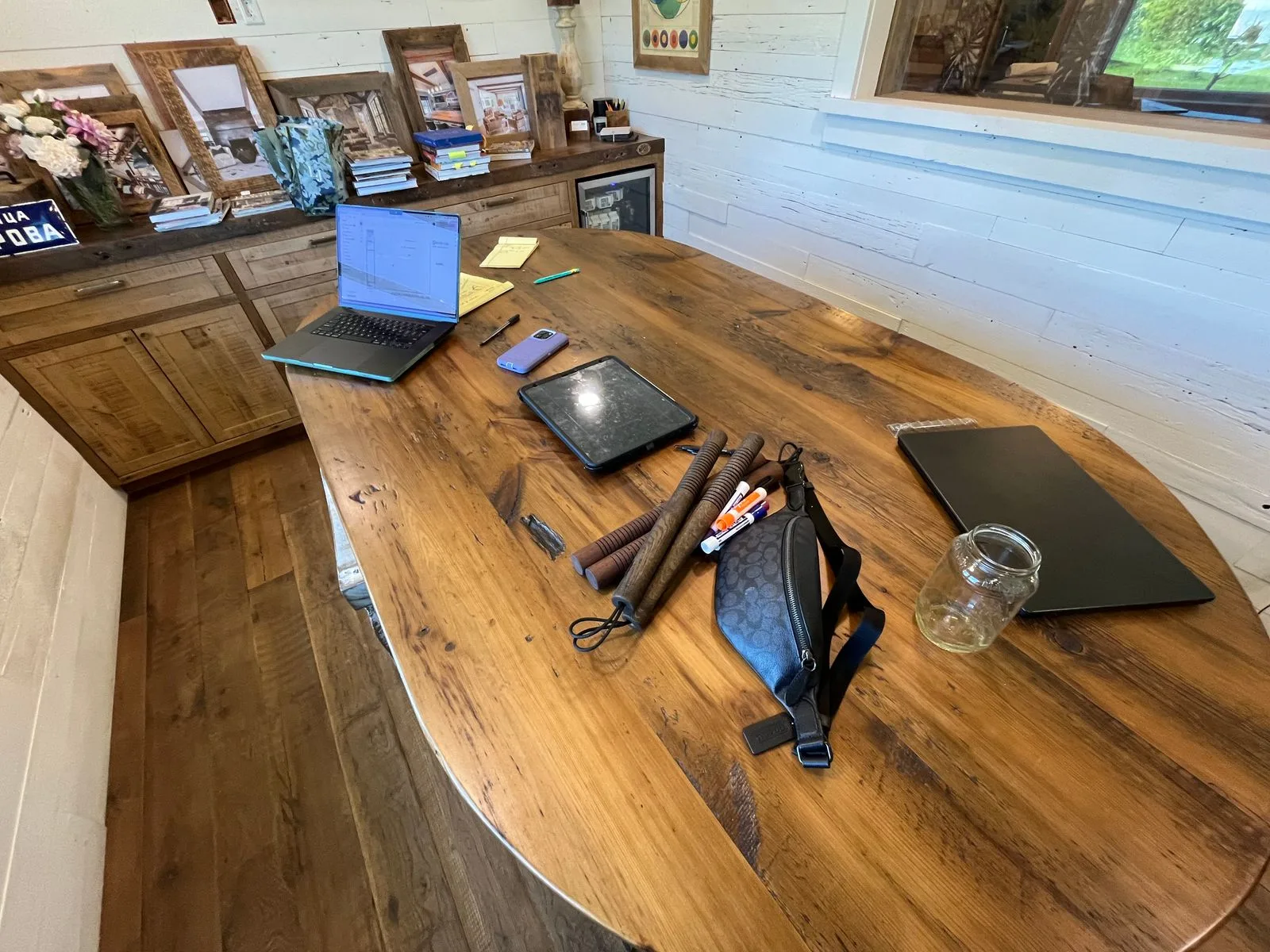
White oak, black stain, and walnut — I’ve written about both. What I hadn’t clocked until I actually started training on them regularly is that the oak pair in particular is long and thick enough that it feels built for someone bigger than me. Taller, heavier, longer arms. A giant’s pair, more or less, that I happen to be borrowing.
I kept training on it anyway. This is what happened.
The size rule nobody follows
Ask around and the sizing advice for nunchaku is pretty consistent: each stick should be roughly the length of your forearm, elbow to somewhere around your fist. Long enough to generate real arc, short enough that you can still see the whole swing coming and correct it before it arrives somewhere you didn’t intend.
Nobody actually measures this. Most people, myself included for three years, just use whatever length a shop sells. The rule exists, it’s just background noise until you accidentally end up outside it.
The oak pair put me outside it. Noticeably.
Why these two came out the size they did
Nobody set out to build an oversized pair. It’s closer to what the reclaimed barn timber actually allowed.
Old-growth barn wood tends to run thicker to begin with. Trees that grew slowly, in unmanaged stands, decades before modern forestry sped growth rates up, pack more growth rings into a wider, denser trunk than most lumber cut today. A blank cut from that stock starts thicker than a blank cut from a fast-rotation plantation tree of the same age, before a lathe ever touches it. These first two pairs weren’t cut down to a standard spec — they were turned close to what the timber gave up. Length followed the same logic: this is what came off this particular board.
If you want something sized to your own forearm instead of to the barn’s, a custom order can specify that. These two just weren’t built that way, and I decided that was more interesting than annoying.
What actually changes when it’s this big
Reach, first and most obviously. The arc is bigger, so the window to intercept it correctly is smaller relative to how fast it’s moving — the tip of a longer stick simply covers more distance per swing, which means more speed on arrival for the same motion at your shoulder. Longer isn’t just “further.” It’s faster at the point that matters, and less forgiving the moment you’re a few degrees off.
I have not hit myself. I want to be honest that this feels like luck holding alongside improvement, not pure improvement. But something real is happening: training with less margin for error is making the margin bigger. I’m reading the return earlier, committing to angles sooner, and staying looser under load because a tense grip on something this size dies immediately instead of just underperforming. Everything the smaller pair let me get away with, this one won’t.
The closest call so far, honestly reported
Today I clipped my fanny pack. Hard.
Given the angle, the direction, and the sheer speed with which my brain evacuated every other thought in my head, I have a fairly confident guess what that swing would have hit without eye drops, bandaids, a wallet, and chapstick in the way — the actual essentials, for someone who loses things easily and needs a bag whose entire job is keeping track of them for him. I’m not going to pretend otherwise for the sake of a cleaner narrative. That’s the actual risk profile of training oversized: not more frequent misses, just uglier ones when they land.
I’m glad I was wearing it. I don’t expect to stop wearing it.
The part I didn’t expect: this is turning into a workout
Three years on a properly-sized pair, this always felt like a hand and wrist thing. A long, thick pair stopped being just that almost immediately.
The handle is thick enough that grip strength alone doesn’t cut it — the hand has to close around real mass, which pulls the forearm in fully rather than letting the fingers do the work alone. Controlling that much swinging weight through a bigger arc pulls the shoulders and upper back into every strike and catch, instead of leaving them as spectators. My stance has to actually hold under the momentum instead of just standing there, which means the core and hips are working too. None of this shows up on a smaller pair the same way, because a smaller pair simply doesn’t have enough mass or arc to ask for it.
I wouldn’t call it a substitute for real strength training. I would call it the most full-body thing I’ve accidentally stumbled into by picking up something that turned out to be the wrong size on purpose.
What I’m actually noticing, day to day
The pattern I described after my first arm drag — hands feeling better on the weeks I train than the weeks I don’t — has gotten more obvious since moving to something this size. My hands hurt less by the end of a desk-work day. My fingers feel more capable of small, deliberate movements, not just stronger in a crude sense. My posture has noticeably opened up, which I think is just the accumulated effect of repeatedly pulling the shoulders through extension and rotation instead of the rounded-forward shape a keyboard builds all day, every day, for years.
I want to be careful here: this is what I’m noticing, not a study. I’m one person self-reporting on one unusually-sized pair of nunchaku, and none of it is medical advice. If your hands hurt for a real reason, see someone qualified before you go add a swinging piece of oversized hardwood to your week because a blog told you it worked out for one guy.
The honest bottom line
Don’t start here. I didn’t start here — this is three years and one private-lesson-taught arm drag and a lot of foam-then-hardwood progression deep before an oversized pair landed in my hands, and even now the margin for a genuinely bad day is thinner than I’d recommend to anyone earlier in the process.
But if you’re already solid on a properly-sized pair and you’re curious what changes when you go bigger: more reach, faster returns, a thicker grip demand that recruits your whole arm instead of just your hand, and — apparently — a much better incentive to keep your form honest than a stick that fits you ever gave me.
Frequently asked
+What's the correct size for nunchaku?
There's no single official standard, but the common rule of thumb is to size each stick to roughly your forearm — from the inside of your elbow to somewhere around your fist when your arm is bent. That gives you an arc you can control at your own reach, which is the entire point of sizing them to the person rather than buying whatever length a shop happens to stock. The two pairs I've been training on are longer than that rule would put me at, on purpose, to see what changes.
+Is it more dangerous to use nunchaku that are too long?
Yes, for a specific and fairly obvious reason: a longer stick moves the tip through more distance per swing, which means more speed at the tip for the same arm motion, which means more energy on arrival and less time to correct a bad angle. Length doesn't just make them reach further, it makes the return faster and less forgiving. I haven't hit myself yet, but the margin for error has clearly gotten smaller, not bigger.
+Does the diameter of nunchaku matter, not just the length?
It changes the workout more than most sizing advice mentions. A thicker handle means your grip can't rely on finger strength alone — the hand has to close around real mass, which pulls in the forearm and, if you're gripping right, the shoulder and upper back on every strike and catch. Reclaimed old-growth barn timber tends to run thicker in the first place, since older trees grew more slowly with more growth rings packed into a larger, denser trunk than most lumber cut today. Bigger diameter wasn't a design goal here so much as what the reclaimed stock happened to allow.
+Can nunchaku practice work more than just your arms?
With a long, heavy pair, yes, more than I expected. Controlling the swing pulls in the shoulders and upper back on the arc, the core and hips have to stabilize against the extra momentum, and your stance does real work keeping you from getting pulled off balance by something this size moving fast. It's not a substitute for structured strength training, but it's a lot more full-body than 'wrist exercise,' which is how I used to describe it to people.
+Can swinging nunchaku help hand pain or finger dexterity?
I can only report my own experience, not a clinical result. On the weeks I train, my hands hurt less by the end of a desk-work day and my fingers feel more capable of small, precise movements than on weeks I don't. My working theory is the wrist rotation through a full range, which is the opposite of the static, slightly-flexed position a keyboard holds your hand in all day. That's a personal observation, not medical advice — anyone with an actual hand or joint condition should ask a doctor or hand therapist before adding a repetitive impact activity, oversized or not.
+Should a beginner start with oversized nunchaku?
No. Everything in this post is what happened when I, already several years into training on standard-sized foam and hardwood chucks, deliberately tried a pair built long and thick. Starting there means learning bad habits at a size and speed that punishes them hardest, with the least room to recover from a mistake. Size to your forearm first. Go bigger, if you're curious, only once the standard size is boring and easy.