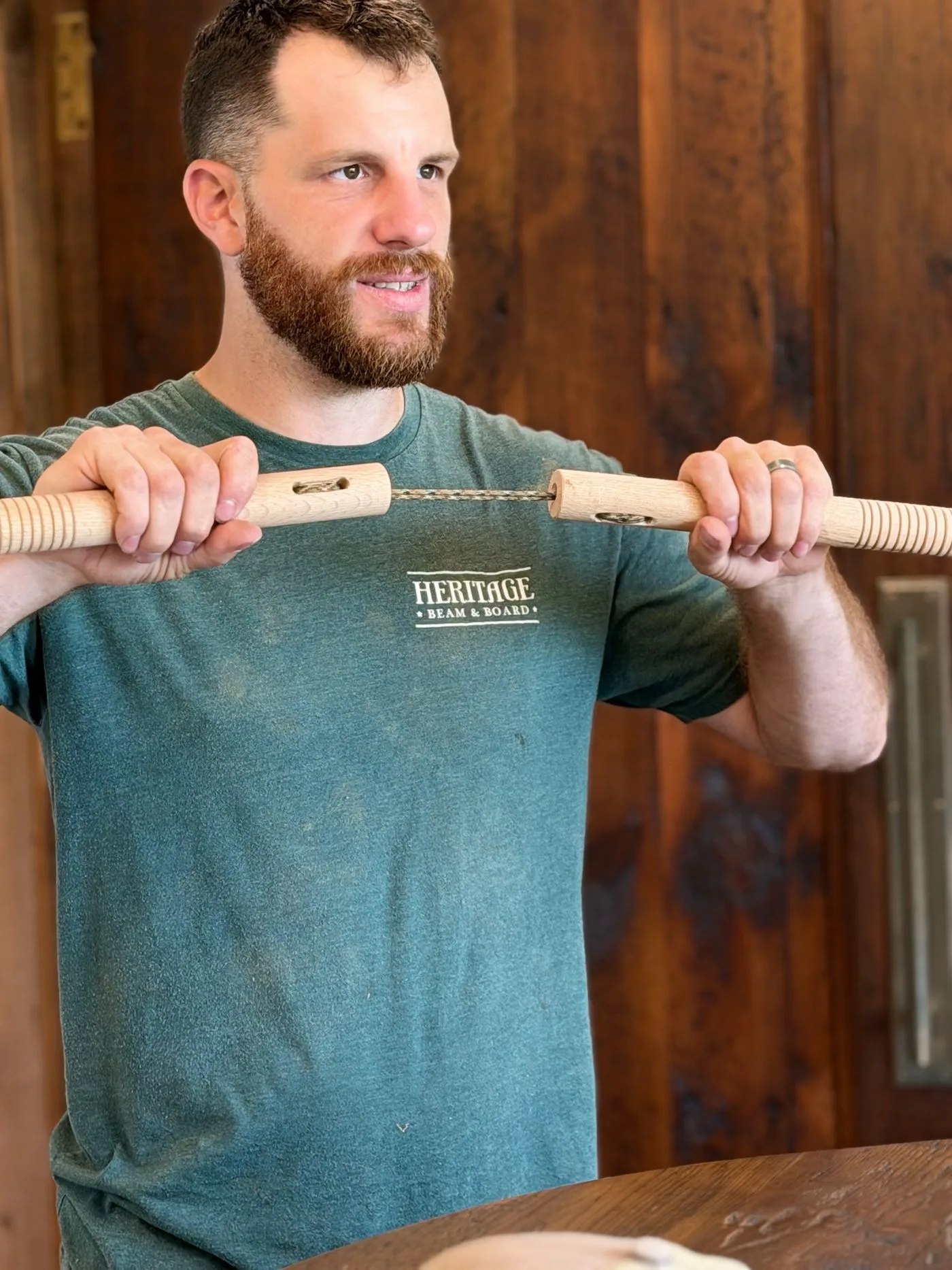
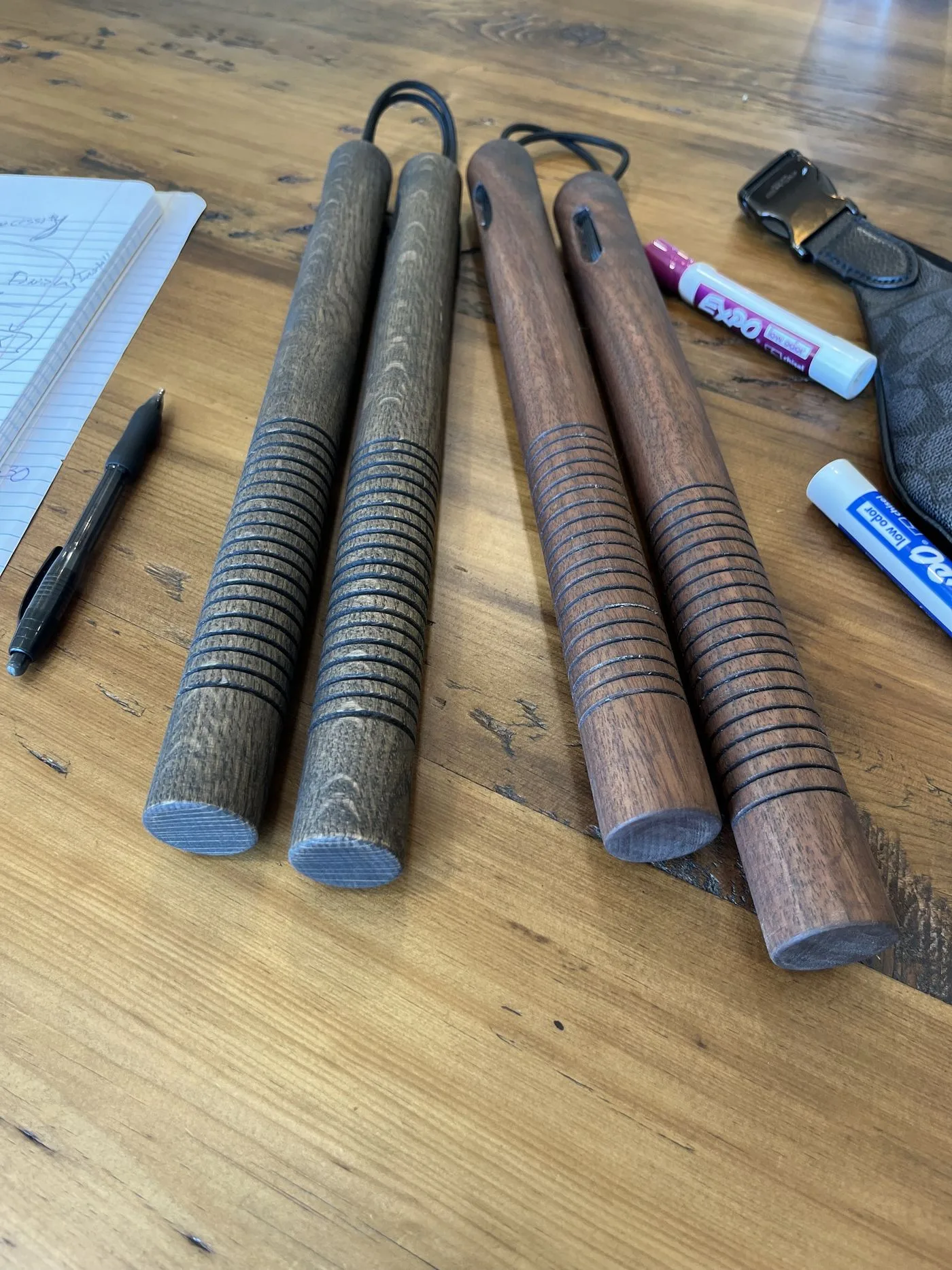
The finished pair — cut grip rings, braided cord, nothing hiding.
Handmade · Made in USA · Reclaimed barn wood
Handmade American Nunchaku
Also spelled nunchucks, nunchuks or numchucks — and sometimes called chucks or chain sticks. Nunchaku is the original Okinawan name for them.
$1,890 per pair
Email to order+ shipping, quoted by email · made to order · nothing charged until you say go
pairs exist right now. That's the entire inventory — nothing held back, nothing made in advance.
Say which one in your email. Want something else? That's a custom order against the next batch of reclaimed stock — see below.
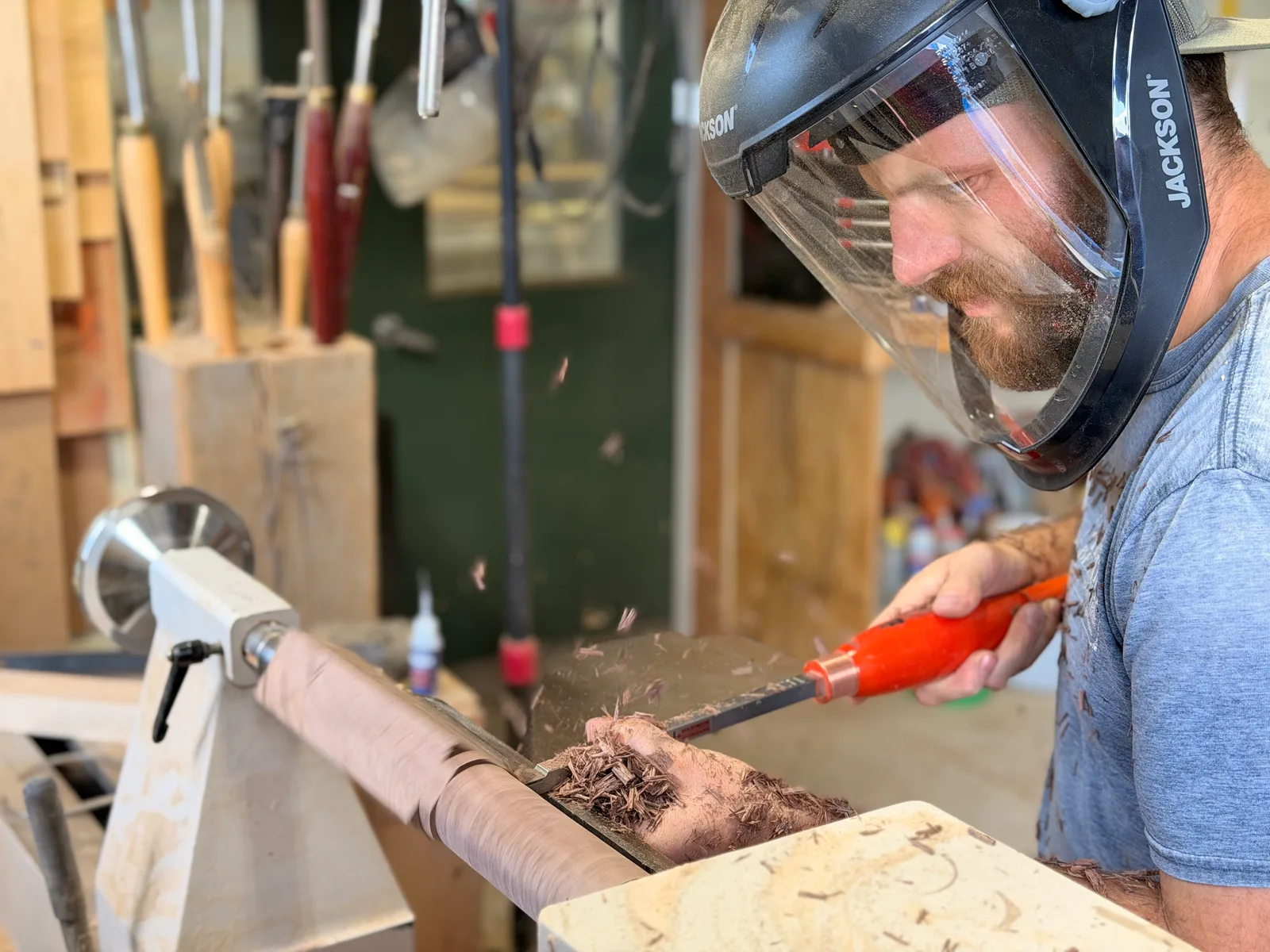
Handcrafted from a barn, not from a catalogue. Search "made in USA nunchucks" and you'll mostly get a stock woodshop photo and no maker. These are the real lathe, mid-cut. The wood was cut from unmanaged native forest decades before commercial forest fertilization existed in this country, and it spent a century holding up a building nobody builds anymore — then went through nine manual steps to get here.
- • Handcrafted in the USA — nine manual steps, barn to finished pair
- • Reclaimed old-growth barn timber, salvaged in southeastern Wisconsin
- • Clear, straight-grained heartwood only — defects get burned, not sold
- • Grain is different in every pair — that barn was built once
Specs
- Origin
- Turned by hand in the USA
- Wood
- Reclaimed barn timber, SE Wisconsin — species varies by stock
- Also spelled
- Nunchucks, nunchuks, chucks
- Finish
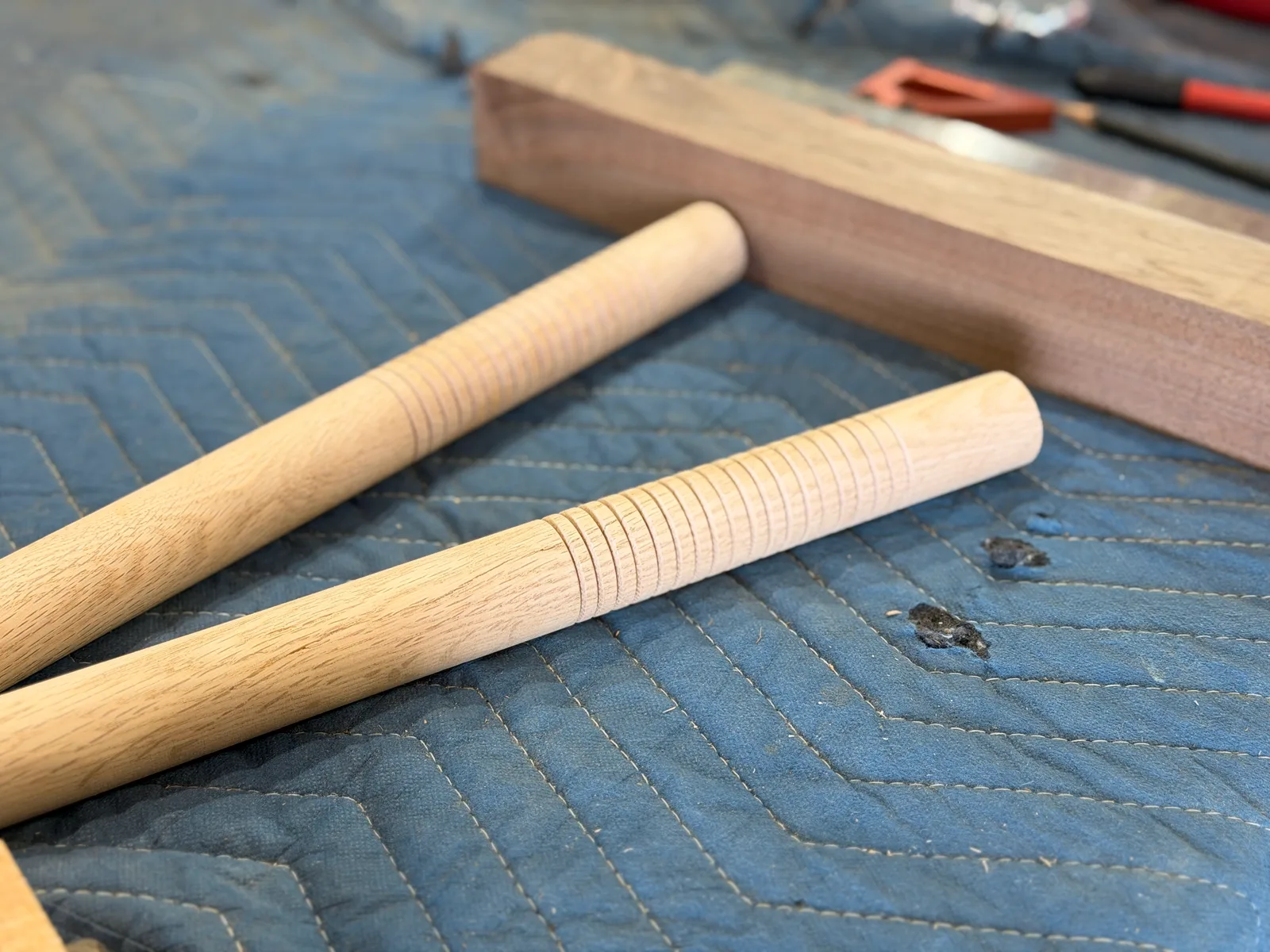
- Hand-sanded, cut grip rings
- Skill level
- Experienced only — not a first pair
- Availability
- 2 ready now (oak, walnut) · custom orders wait on the next batch
Handcrafted, start to finish
From a standing barn to a finished pair
Every step below is done by hand, in the United States. Nothing is cut on a CNC, nothing is finished offshore, and nothing shows up in a box already shaped. Most of what gets sold as handmade nunchaku skips the first six of these entirely, because the wood arrives ready to turn. This is the whole chain, which is why one barn yields so few pairs.
- 01
The barn comes down
Hand deconstruction, not demolition. A period barn is taken apart board by board and beam by beam so the timber survives the process — which is slower and more expensive than putting a machine through it, and the only way to get usable stock out.
- 02
De-nailing and cleaning
A century of hardware comes out by hand: cut nails, spikes, staples, old hinge plates. Then the dirt, chaff and loose paint. Miss one nail and it finds a lathe tool later at speed.
- 03
Heat treatment
Old barn wood has usually been lived in by something. The timber is heated through to core temperature to kill any insects, larvae or eggs still in it, so nothing hatches out of a finished handle a year from now.
- 04
Drying
Brought down to a stable moisture content. Wood that goes into a striking tool still carrying barn moisture will move, check and split after it reaches you — this step is why it doesn't.
- 05
Then it sits
Stored and left alone to settle. Time is the only thing that reveals hidden movement, and the point of waiting is that any board that was going to twist or check does it here, on a rack, instead of in your hands.
- 06
Cut and graded
Milled down to blanks, and this is where most of the board is lost. Clear straight-grained heartwood only. Anything with a nail hole, a check, or an insect gallery near a striking end gets burned rather than sold.
- 07
Turned by hand
One handle at a time on the lathe, spun and shaped by hand. No CNC, no duplicator, no two identical. The photos on this page are that step actually happening.
- 08
Sanded and finished
Hand-sanded up through the grits, grip rings cut, and the finish worked in by hand. This is the longest part and the one nobody sees, and it's the difference between a turned stick and something you want to hold.
- 09
Corded and checked
Holes drilled, cord fitted and knotted by hand, and the pair checked under load before it goes anywhere. The cord is the part that fails first on cheap sets, so it's the part done last and slowest.
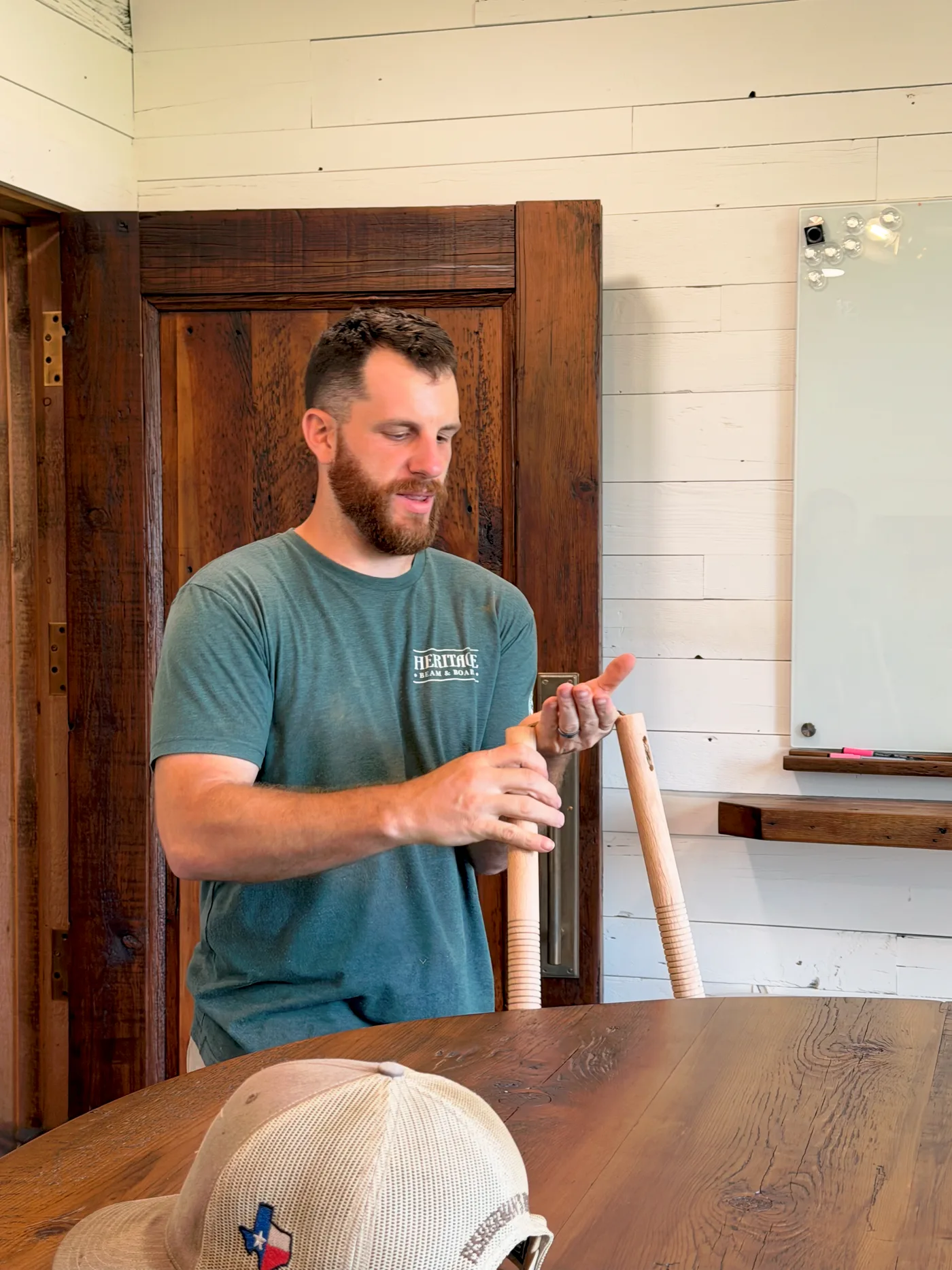
Where the timber comes from. The reclaimed stock is salvaged in Elkhorn, Wisconsin by Heritage Beam & Board, who install reclaimed board and beam and do custom wood work. They're a client of mine — worth knowing before you read me recommending anything — and it's the reason I can get these built out of century-old barn timber at all. It's also the first time they've made nunchaku.
Picked up in person · Elkhorn, Wisconsin
Reclaimed wood isn't one wood
The last photo in the gallery above is the two finished pairs on hand right now, photographed the day I drove up to collect them: white oak with a black stain, and walnut. Neither was built to a spec — they're just what the same reclaimed stock yielded.
That's the honest answer for a custom order too. Reclaimed barn timber isn't a lumber yard with a standing catalogue — species, grain and finish depend on what a given barn's stock survives grading. A custom order can specify a preference; the material has the final vote.
In stock right now: one pair of each — 2 total, no more, no less. When they're gone, a new pair is made against whatever reclaimed stock is on the rack next.
What swinging these actually does
Nunchaku practice looks like flash. Most of the benefit is quieter than that and lands in the places a grappler and a keyboard worker both need — the hands, the forearms, the wrists, and the timing that connects them.
Grip and forearm endurance
You're controlling a swinging weight through constant grip changes. Forearms load in a way that carries over directly to holding a collar, a sleeve, or a wrist when your hands are already tired.
Wrist rotation through full range
Every strike and return rotates the wrist through positions a keyboard never asks for. If your hands live in one static, slightly flexed shape all day, this is the opposite of that.
Timing under a moving object
The chuck returns whether or not you're ready. Reading a moving thing and meeting it in the right place is the same skill as catching a grip mid-scramble.
Your off hand stops being useless
Serious practice forces both hands to work. Most people discover their non-dominant side is years behind, which is equally true on the mat.
Relaxation under speed
Grip too hard and the movement dies. You learn to stay loose while something moves fast near your head — a lesson that transfers straight into rolling tense.
Shoulders and posture
The arcs pull your shoulders through extension and rotation instead of the rounded-forward position a desk builds. It's not a cure for anything, but it's movement in the right direction.
This is training experience, not medical advice. If you have a joint, nerve, or tendon issue — carpal tunnel, arthritis, a bad elbow — talk to someone qualified before adding a repetitive impact activity, not after.
Read this before you buy
These are not a beginner's tool
Dense reclaimed hardwood on a cord, moving at speed, a few inches from your own hands and skull. There is no version of the early learning curve where you don't hit yourself — the only question is what you're holding when it happens. A light foam set teaches you the same patterns and leaves a bruise you forget about. This set will not.
What actually goes wrong
- • The return, almost every time. Strikes are easy; the swing coming back is what catches the back of your head, your elbow, or your own knuckles.
- • Bruised forearms and elbows for the first months, guaranteed.
- • Fingers and wrists caught between the cord and a handle during a bad catch.
- • Teeth and eyes. Rare, permanent, and the reason people wear eye protection.
- • Everything within a two-metre radius — lamps, screens, doorframes, pets, and anyone who wandered in behind you.
How to earn your way to hardwood
- • Start on foam or padded chucks. Months, not weekends.
- • Drill slowly until returns are reliable — speed hides nothing, it just costs more.
- • Eye protection, every session, including the ones you think are easy.
- • Train with space around you, outdoors or a clear garage. Not a living room.
- • Respect the extra mass. Dense old timber carries more energy than the light import you learned on, so everything hits harder — including you.
None of this is here to be dramatic. It's here because we'd rather lose the sale than have a beautiful object put someone in urgent care in week one. If you're new to this, buy a cheap foam set instead and come back in a year — the barn wood isn't going anywhere.
Nunchaku FAQ
+Is it spelled nunchucks or nunchaku?
Nunchaku is the correct name — they're an Okinawan kobudo weapon, and that's the spelling used by every serious martial arts source and by the plural too (there's no 's'). Nunchucks is an American corruption that stuck, largely through 1970s film, and it's what most people say and search for. You'll also see nunchuks, numchucks, chucks and chain sticks. None of them are wrong enough to argue about — we use nunchaku on this page because it's accurate, and nunchucks because it's what you probably typed to get here.
+Are these nunchucks really handmade in the USA?
Yes, and the page shows the work rather than asking you to take it on faith. There are nine manual steps between a standing barn and a finished pair: hand deconstruction, de-nailing, heat treatment, drying, resting, milling and grading, turning one handle at a time on a lathe, hand-sanding and finishing, then cording by hand. The timber is reclaimed barn wood from southeastern Wisconsin and every pair is turned here in the States. The photos are that process actually happening, not stock images. Most products marketed as handmade skip straight to the turning step, because their wood arrives ready to cut.
+What wood species are available?
Whatever the reclaimed stock actually yields — the two finished pairs on hand right now are white oak with a black stain and natural walnut, both cut from the same barn timber on the rack. A custom order can specify a preferred species or finish, but reclaimed barn wood isn't a lumber-yard catalogue: the final species depends on what a given barn's stock survives grading. See both current pairs above.
+Why reclaimed barn wood instead of new hardwood?
Honestly? For what it is and where it came from, not because it outperforms new hickory. This timber was cut from unmanaged native forest decades before commercial forest fertilization existed in the US, in dense closed-canopy stands where trees self-pruned their lower limbs — which is why old barn stock so often yields long, clear, straight-grained pieces. Clear straight grain is what actually matters in a striking tool. Every pair also carries grain you cannot buy new, because that barn only got built once.
+Is old barn wood stronger than modern lumber?
Sometimes, and we're not going to pretend it's a universal rule. Old-growth softwood genuinely is denser and stiffer than today's fast-rotation plantation lumber, because it contains far less low-density juvenile wood. But for ring-porous hardwoods the picture can reverse, and age itself isn't what makes a striking tool hold up — species and clear, defect-free grain are. What we control is selection: species first, clear heartwood only, and any blank with a nail hole, check, or insect gallery near a striking end goes in the burn pile. That rejection rate is a big part of why one barn yields so few pairs.
+Why do they cost $1,890?
Because of what goes into one pair: reclaimed stock has to be sourced, de-nailed, dried, graded for hidden checks and insect damage, and then turned one handle at a time on a lathe. Most of the board doesn't survive that process. This is heirloom-tier pricing for an object made in very small numbers, not a training-gear price. If you want a beater pair to learn on, buy a cheap foam set — genuinely.
+Are these good for beginners?
No. Hardwood nunchaku are unforgiving, and the entire early learning curve is paid for in bruised forearms, elbows, and the back of your own head. Learn the movement patterns on foam or padded chucks first, get your timing and returns reliable, and move to hardwood only when you stop hitting yourself. We would rather talk you out of a purchase than sell you an injury.
+Are nunchucks legal to own?
In most of the United States, yes. Several long-standing bans — New York's among them — were struck down or repealed since 2018, so a lot of what's written online about this is out of date. We do not ship to Massachusetts, where state law still makes selling nunchaku a crime, or to Rhode Island, whose weapons statute reaches them. A few other states and cities are ambiguous, and rules on carrying in public, in a vehicle, or near a school vary widely even where ownership is fine. Check your own state and municipal code before ordering. This isn't legal advice — by ordering you're confirming you're 18 or older and that owning this is legal at your address.
+How do I order a pair?
Email itylergarrett@gmail.com with "Nunchucks" in the subject. Each pair is made to order against whatever reclaimed stock is on hand, so turnaround varies — you'll get a lead time, the wood it's coming from, and shipping cost by email before anything is made or charged.
+Do you ship internationally?
US only for now. Customs treatment of nunchaku varies enormously country to country, and several places seize them outright, so we're not going to take your money and gamble with a package worth this much.